Let It Sit or Use It: Acclimating Wood
“Be sure to let the wood acclimate before you use it.”
That’s what every knowledgable woodworker will tell you about wood. After all, it has to be in equilibrium with its environment to ensure a good, long-lasting result. I personally preach this to everyone I meet, if they are willing to listen (and sometimes when they are not). But, it’s not as simple as just letting the wood sit before you use it. Sometimes letting the wood acclimate to its new environment is actually a bad idea.
The logic behind letting wood acclimate before you use it is to have all of the craziness of wood movement happen before it is installed. If the wood is moved to a dry environment it is going to shrink and if it is moved into a wet environment it is going to expand. This “dry” or “wet” description is relative though – wood moisture in relation to the environmental moisture (humidity).
I often think of wood trim and casework when I think of acclimating wood to its environment, with a close second being hardwood flooring. In a perfect world, I would install both of these items on the 2nd of February after the heat has been running in the house for months and everything is shrunk up as much as possible. In this shrunk up world, I want my flooring or trim to be super dry and super shrunk so everything fits nice and tight and only tightens up as summer rolls around and the humidity rises. However, the opposite is usually true. I seem to only install woodwork around July 20th, when the humidity is a billion percent and everything is fat, which means in the winter everything will shrink and gaps will appear.
“Well pal, if you weren’t such an idiot and you let that wood acclimate before you installed it, everything would be great and the gaps that open in the winter would be a thing of the past.”
Not true, I say. Remember, the dry and wet thing is relative. Letting the wood acclimate in winter to a super dry environment is good. Your wood will most likely be shrinking (it definitely won’t be expanding if the heat is running all day long). You will install everything tight and it will only get tighter as the summer rolls around. This is good – in winter.
In summer, the opposite is true. Say that you take your wood flooring that is dried to 6% to a job site in the summer. Your flooring is shrunk, it is small and ready to be installed. Yes, it will swell up in the humidity of summer, but you want it installed when the wood is shrunk so it will expand and only tighten up. Letting it acclimate in the summer only ensures that you are installing fatter wood, which is guaranteed to open up in the winter. Flooring will show gaps between boards and casework will open up at the seams.
I think the whole acclimation just-do-it, don’t-think-about-it thing started because there are so many chances in life to have wood that is a little too wet going in to an environment that could use drier wood. This, perhaps, isn’t the case in the deep south, but I would say it is the norm for much of the country. Wood has too many opportunities to pick up extraneous moisture before it makes it into its final resting place. From sawmills and distributors to retailers, lumber is stored in environments that are not climate controlled, possibly for quite a while, picking up moisture the entire time. And, even after it makes its way into your hands it may spend time in a garage, shed or job site that isn’t climate controlled.
The default in all of these cases is to get the wood inside, in a climate controlled environment and let it acclimate to the environment, but what we really mean is to let the wood dry. I have never had an issue with interior woodwork being too dry and causing a problem after it swelled up. Again, in the high humidity of the deep south this might be a problem, but for most of us wood can’t be too dry. It is almost always a little wet.
So, what to do in summer. Say you’ve got wood that just came out of the kiln and is dried to a target of 6-8%. Do you take it to the job site and let it acclimate, knowing that it is going to pick up moisture and get fatter before you install it, just to shrink again in the winter? I say, “Heck no!” It makes zero sense to let the wood acclimate in this scenario. If the wood is dry, put it in – and fast.
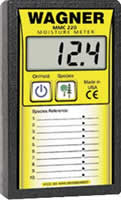
I have found this Wagner MMC 220 pinless moisture meter to be the most reliable and easiest to use. It gives deeper more rliable readings than a pin-type meter without damaging the wood.
The key in any scenario is knowing the moisture level of your wood and what the acclimating environment is going to do to it. A reliable moisture meter is a good place to start. Test your wood, and if it is dry based on your area of the country, start using it. Refer to the chart at the end of this post to see what moisture content your wood should be. If you don’t have a moisture meter, assume that the wood is a little wet (since it usually is).
In the dead of winter letting the wood acclimate is always a good idea because it can’t really cause a problem. It won’t improve your lumber if it is already dry, but it won’t hurt it, and it will only help wet lumber. Winter is by far the best time of the year to install interior woodwork.
In the spring and fall acclimating wood is likely to have little to no effect. Heat and air conditioning will be running less, windows will be open, and humidity levels will be closer to outdoor levels. Only let your wood acclimate during this time of year if you know it is wet and could benefit from some drying. If it reads as dry on a moisture meter and/or hasn’t spent awhile in an environment without any climate control, start using it.
Acclimating your wood in summer only really makes sense if you know that your wood is extra wet, either because your moisture meter told you so or because the lumber was stored in an environment that wasn’t climate controlled. If your lumber is in a condition that acclimating it during the summer makes sense, you may want to reevaluate your situation. In this case, additional drying, not just acclimating, may be necessary. Summer is the worst time to install interior woodwork.
Use common sense when deciding whether or not to acclimate wood. If the environment is extra dry, no matter the time of year, let it acclimate. If humidity levels are extra high, it probably makes sense to start using the lumber right away. Any other times, when the humidity is moderate, you are probably just kissing your sister (getting no benefit) and possibly making the wood worse by letting it acclimate.

This chart shows the high (summer) and low (winter) moisture levels for interior wood throughout the country. In a perfect world, your wood will read at the lower number when installed.
What’s Going on at WunderWoods

Everyone always asks what I do. Here's the answer. Click on the photo above for a short video tour and see all of the steps it takes to go from a tree to finished furniture.