Easy Sign, Difficult Customer
At the end of May, my daughter and pickiest customer Mira, turned eight and planned to have a mermaid swimming party at Grandma’s house. Grandma has a swimming pool and we knew that she would be willing to heat it for an early-season swim, so it was an easy choice. The difficult part was finding mermaid themed items that met with Mira’s approval and weren’t for little girls (Ariel, A.K.A. The Little Mermaid, is not cool when you are eight).
While searching for party decorations, my wife, Chris, came across a little sign that she thought was cute and asked if I could make one for the party. It said, “Mermaid Lagoon” and it was pretty simple, and since it was right up my alley, being made of wood and all, I said “Yes”.
I dug out some cypress that had lots of knots and a good rustic look and started cutting. I wanted the sign to be bigger (who wouldn’t) than the one in the photo, so I cut the boards about two feet long to make the height. I trimmed the ends at random lengths, some at a slight angle, until I had enough to make the sign about three feet wide. It went quick, especially since I had no formal plan. If a board didn’t look right, I just trimmed it more or flipped it around or just grabbed another board. I love that kind of woodworking; no tape measure, no pencil, no worries.
After I nailed the boards together, I painted them with a wash of blue/green paint. I already had some bright blue paint in the shop and added green Transtint to get the color right. I thinned the paint down with water and brushed it on as quick as possible. While it was still wet, I wiped it off like it was a stain to show the wood below.
Once the paint was dry, I did the lettering, which I laid out and printed from the computer. I cut out the words with an X-acto knife and used a light coat of Super 77 spray adhesive to hold it in place while I painted it. A light mist of white spray paint did the trick, making the words legible but not too pronounced.
After the sign panel was assembled and painted, I needed to come up with a post. My first attempt was a weathered piece of oak 2″x4″. It had the right look and feel since it was old and gray, but I thought that Mira might not approve since it just looked like an old board, so I continued to search for a better way to display it.
A quick walk to the other end of the shop revealed a piece of driftwood that was perfect. It was the right size and height, and with just a little block added to the bottom, it sat up beautifully crooked. Plus, I wouldn’t have to pound it in the concrete-like ground since it would stand up on its own. That piece of white oak driftwood couldn’t have worked out better.
All that was left to do was screw the sign to the post, which took a grand total of 30 seconds. If it was going to be for long-term use I would have been more serious about it, but two 3″ deck screws worked just fine and quickly put this job to bed.

The perfect piece of white oak driftwood and cypress lumber teamed up to make this sign for my daughter Mira’s swimming party.
I was pleased as punch. I showed it to everyone within shouting distance of the shop and couldn’t wait to bring it home and show the girls. They were pleasantly surprised at how it turned out and I was pleasantly surprised that Mira quickly approved it (I was still a bit worried that my unauthorized driftwood addition might have been a bit aggressive in her mind (even though it was perfect)). We capped the whole thing off with hot glue, a few seashells and then perfect weather for a “Mermaid Lagoon” swimming party.
The sign now resides in my shop, where it generates many inquiries, but as of today, no more official orders for driftwood mermaid signs.
You Won’t Believe The Trees At Elephant Rocks State Park

This photo by Aaron Fuhrman (Aaron Fuhrman Photography) was taken at the top looking towards the biggest elephant rocks. Click on the photo to visit Aaron’s website and view his beautiful landscape photography.
We recently went to Elephant Rocks State Park, the home of largest round granite boulders and awe-inspiring landscape in the great state of Missouri, for a second time. On our first visit we almost missed the main attraction because we were a little too adventurous. We took a side trail, missed the easy entry to the top, and only found the path up the center as we were leaving. Looking back, it seems almost impossible to do, but we did it. The trees were thick, and we just couldn’t tell where to go. In that case, we should have followed all of the wacky kids that ran up through the trees and disappeared (I guess they had been there before).
On this trip we knew how to get to the big rocks, but started by cruising the perimeter a bit before lunch, and we found even more cool stuff that we missed on the first trip. To the right of the parking lot, the rocks make a nice surrounding for the picnic tables, and are where we started to explore. Once we got up past the picnic tables and started climbing, we quickly went into slow-down-Mira mode, so that she could live to see the rest of the park.
We got Mira to focus, get away from the edge, and stop running and quickly found a quarry pond with steep ledges and more big round rocks, that we hadn’t seen on the first trip. After we were done checking out the new-found area, we headed down for lunch. On the way back down, I noticed for the first time (really noticed) the trees growing on the top of the rocks. I found a dead log and brought it back with me so I could slice it and take a photo. For those of you wondering, all of the signs said don’t take the rocks, they didn’t say a thing about dead logs. Anyway, here is a picture of the unbelievable 28-year-old post oak log. Click on the photo to see what makes it so unbelievable.

This post oak log from Elephant Rocks is about 28 years old. Click on it to see what makes it special.
I knew that it would be a slow grower since it was growing on top of a rock, but it was really slow. The log is a tiny, itty-bitty 1-1/4″ in diameter. At that rate, to grow to a reasonable-sized log for milling of about 18″, it would take 409 years or maybe never even make it. To put that more into perspective, a normal slow-growing tree would have about eight rings per inch. This one had about 40, and so close together that they are hard to see.
The tree it came from was small and stunted, trying to grow out of a crack in the granite. It looked like many of the trees directly on the rocks. One of them can be seen in the first photo and another is pictured below.

With a trunk diameter of 6″, this 8′ tall post oak is over 100 years old.
A few trees were much larger. Perhaps they were very old or just had more soil to work with, even though they were in a tough spot. I was surprised to see a tree this size in this spot.

This black oak managed to get much larger. Maybe it is 300 years old.
We also found many trees with odd shapes, trying to work their way through the rocks. After this next post oak, I was told to stop taking tree photos and move on by both of my boss’.
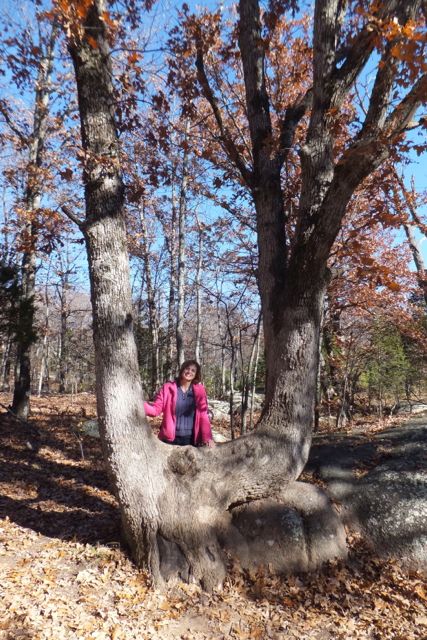
This post oak is good for climbing too.
From then on we enjoyed the rest of the park and spent our time climbing on the rocks. We followed the very nice asphalt trail that makes a loop around the rocks and takes you to the top. The following photo shows you the other reason (besides the trees) for going to the top of the mountain. The rocks are unbelievably giant. It is amazing how big the rocks are and that they don’t just roll down the hill. By the way, that is not my family.

This is the biggest rock at Elephant Rocks. Courtesy Aaron Fuhrman Photography.
This is how the rest of the park looked when we visited on November 10th:
-

- Even the smaller rocks at the top are big.
-

- Though covered in leaves, there is a nice asphalt path around the park.
-

- This is the quarry where the pink granite was removed.
-

- The rocks on this side invite visitors to sit on the different levels and enjoy the view.
-

- Elephant Rocks has plenty of spots to squeeze and crawl through.
-

- This is from the top looking down the mountain. The entire slope is a big chunk of granite, with round granite boulders on top.
-

- You can’t go to Elephant Rocks and not take a photo holding one up.
If you have never been to Elephant Rocks, I highly recommend that you go. If you have been there before, I highly recommend that you go again. It is truly amazing, and at about 1-1/2 hours south of St. Louis, worth the drive.
Below are a few notes that I put together after just two trips to Elephant Rocks. If you have been there before, feel free to add your own in the reply section.
Notes for visiting Elephant Rocks:
- Granite gets warm. The park has lots of shade from the trees, but the open spans of granite get toasty in the sun.
- Plan to stay awhile. The path around the park is only a mile, but there are lots of things to see and explore.
- Bring a lunch. There are many nice picnic tables around the parking lot, all situated among trees and rocks.
- Be ready to climb. The entire park is open to be explored. Older kids (and some adults) will be jumping from rock to rock, rock climbers will be honing their skills, and parents of little ones will be very nervous. Even so, there are plenty of places to safely explore close to the ground.
- Granite is slippery. Some spots are well worn, polished and smooth. Don’t be afraid to get down on your butt. You will end up there anyway.
- Bring your camera. You will definitely need a photo of yourself holding up a giant rock.
-

From this point head straight up through the trees to the big rocks.
Don’t miss the biggest rocks. At the bottom of the hill and the entrance to the loop Braille Trail, is what I will call the “foyer” of the park. At this spot, which has a single rock with a ring of asphalt around it, you can head directly into the trees and up the mountain. It is not marked as a trail or a path, but others will most likely be headed through this passage. This is the spot we missed the first time because it is not identified at all, especially compared to the very nice trail that heads away to either side. When there are no leaves on the trees the path will be obvious. Otherwise, just trust me and head up the gut to the top. Do note that heading up the center is on the granite rock and not on an asphalt path. It isn’t too hard to climb, but it isn’t for everyone. If you think you might have trouble climbing the rock, just follow the main trail around the back and to the top. You will end up in the same spot.

Martin Goebel Has Big Plans

Martin likes big logs too.
About a week ago we milled a big Black Oak log for our friend Martin Goebel of Goebel & Co. Furniture. It looks like he has some big plans, and they include a large tabletop for a customer. Our mission was to get at least one good slab, cut at 4″ thick, that would stay together through the drying process. The log was stout with a lot of character and a few bad spots, but it was so big that getting some slabs that met the requirement was no problem.
This is the first log that I have milled on the Lucas Mill that required the mill to be jacked up (by about 10″) to get started. The mill will cut up to 62″ wide with the chainsaw slabber attachment, and we still had to trim both sides of the butt end for the log to fit. We milled the bottom log with the slabber, and Roger Branson of Red Rooster Sawmill cut up the top logs on his Wood-Mizer LT40. In all we got about 1,600 bd. ft. out of the tree, with about 1,000 bd. ft. coming out of the bottom 10′ log.
Here are the photos of the event:

Even with the mill jacked up and elevated as high as it would go, the log needed to be trimmed for the mill to work.

After we got a level work surface, it was easier to work on top of the log.

This is a manual mill and needs to be pushed through the cut. To speed things up, Scott helped Dan push the mill.

This is the natural-edge slab Martin picked out for the tabletop. It is just over 10′ long and 5′ wide on the end with the trimmed sides. It was cut 4″ thick and will take over a year to dry, even with the help of a kiln. There are a couple of spots that Martin sealed up to help prevent large cracks. Overall, an impressive piece of wood.
After the milling we got all of the wood back in the shop and stacked to start drying. It is nutty to know that the lumber is so big that it takes two of us just to slide one end of the slab on to the sticks. Luckily, the stacking is done, and now we wait, with our fingers crossed, in hopes that nothing breaks as it dries.
Skidding Logs Without The Ruts
I always think I am going to do a short post, especially late at night, but I never seem to pull it off. This will be an exception. Introducing, my first, official, quick short post.
Problem:
Logs in back yard, truck with winch in front yard, nice lawn between the two.
My job:
Get logs out without tearing up the yard.
Solution:

Roll the logs on to 3/4″ plywood with the cant hook.

Hook plywood to the cable and pull.
Now… if it was just that easy, short and simple I would have nothing to talk about, would I?
(Stop reading here if you don’t have a little extra time and a tiny violin to play.)
This tree was only two houses away, and I have had my eye on it since it started dying last fall. It was a nice white oak that had a 11′ long veneer-grade log in it and two lower-grade 9′ long logs (the logs in the skidding pictures are the upper logs, not the veneer quality log). The tree was quickly declining through this summer of death and was totally dead when I got to it. It was still solid and the heartwood looked good, but the sapwood had started spalting (rotting), and the bugs had moved in. Even though I wouldn’t be able to sell the log for veneer because of the lack of freshness, I still deemed this tree worthy of a little effort to procure. Notice I said a little.
I got out to meet the tree crew early on the Friday after Thanksgiving. Chris woke me up. She was telling me that the tree guys were there, but all I needed to hear was the word chainsaw, and I was out the door in a flash. I trust no one to cut a tree correctly. It goes back to when a friend of mine cut a 30″ diameter walnut tree 24″ up from the ground and turned a $1,500 log into a $300 log. He knows all of the best wood is close to the ground. He just got lazy. Now I remind everyone to cut low and tell them, “Get your chainsaw dirty.”
As far as the felling, things went great. The guys were accommodating and cut the tree perfectly (I think they were happy to leave the big parts on the ground and still get paid). I headed home to let them wrap up and returned in the afternoon with my log truck to start skidding the logs.
From the spot where I set up I had a straight shot to two of the logs, but the stump was still there and in the way of the main log. I figured I would get those two logs and stop by the next day to pick up the last one after the stump was ground up.
The three logs were in the back yard and down a pretty good incline. I wouldn’t call it steep, but it is strongly downhill and the logs needed to go uphill. My normal skidding technique is to hook a cable up to the log and pull. This works fine, but it can also tear up the yard. It does a lot less damage than driving a log truck in the yard, but it can still scalp the lawn when it is soft. I had told the apprehensive homeowners that I would use my “improved” normal method, which was to put a piece of plywood under the log and skid it like a sled and not tear up the yard. I have done this many times in the past, but always on more level lawns. Still, I figured it shouldn’t change things too much. It’s just a hill, what’s a little hill? A big problem, that’s what!
The gravity opposing operation proved to be quite time-consuming. Just getting the logs on the plywood took awhile, even with one of my neighbors helping (he was watching out the window and couldn’t handle it). It seemed like everything we did was uphill.
Once the logs were on the plywood the sailing should have been smooth – pull them up and go home. But, they kept hanging up in the yard, and since I was working alone and couldn’t see the logs I would just pull until something obvious happened. By then I had pulled the plywood out from under the log and had to reconvene with the logs at the bottom of the hill.
After a few attempts I figured out what the problem was. It was simple physics. The logs were long and straight(ish). The hill had a couple of dips in it that would grab the nose of the log or the leading edge of the plywood. In the woods, I would just pull through it and move the dirt out of the way, or if it was an episode of Axmen, I would break something and yell down the hill, “Are you guys O.K.?”, even though I knew they were fine.
I did a little of both (pulling and yelling). I pulled and re-rigged and pulled some more until I got a log out. Then, home I went. I had worked on the logs for hours, now it was dark, and I only had one of the top logs out. The one I really wanted was still in the back yard behind the stump and behind another log.
The tree guys were supposed to come first thing Saturday morning to finish grinding the stump. They didn’t finish friday night because they had an issue with the stump grinder. I got to work because the stump wasn’t in the way of the second log. Again, it was going to work out perfectly. I would pull out a log while they fixed the grinder and then I would pull out the last log.
The second log turned out to be just as cantankerous. More pulling. More yelling (I don’t really yell, but you get the picture).
The entire time I was working on the second log the tree guy was working on the grinder and he was yelling. He put in two new starters on Saturday after another guy put in a new battery on Friday night. I tried to be as helpful as possible because I needed him out of there at some point. We looked at what was happening, and even though I am not much of a mechanic, I offered some advice. It seemed like the starter was working, but not engaging. I have messed with my share of starters, and it acted like it was running backwards. I told him to check to make sure the new battery was hooked up right. I wasn’t sure if that would make the starter spin the wrong direction, but it made sense in my head. He checked it out and said the it was hooked up correctly. I had no other ideas, so I left him alone.
I got my second log out, and then the tree service mechanic asked if I could move my truck so he could drive his Chevy Trailblazer down and try jumping the grinder. I have no idea what that was going to do, but I didn’t have a better idea, so I went with it. I handed him my jumper cables, moved my truck and he moved his Trailblazer down the hill to the stump. It didn’t take long for the mechanic to yell, “The battery’s hooked up backwards.” That was a bonehead move, but I was happy that he got the grinder working and was getting out of my way. Well, sort of.
He went to back out and his tires started spinning. This is a common problem for guys like me with two-wheel (I call them one-wheel) drive vehicles. If you spit in front of my trucks the tires spin, but not on a Trailblazer. “Hey idiot, put it in four-wheel drive,” I thought almost out loud. But his truck didn’t go in to four-wheel drive. I couldn’t believe it, something went wrong, amazing!
“Can you pull me out?” he asked me.
I was a little irritated, but a little relieved because it is usually me asking to be pulled out (I can bury a truck in the mud like nobody’s business). I pulled him out and packed up to finish my Saturday morning project, which started on Friday and was now going in to Monday.
By the time Monday rolled around I had it all figured out. The stump was out of the way, and all I had to do was pull out the best log. It was about a 26″ diameter (on the skinny end), 11′ long white oak log, and it did not want to go on or stay on the plywood. I used straps, wraps, blocks and schmocks (don’t forget locks) to try to keep it on the plywood, but everything just kept digging in and the log kept coming off. This last log was longer than the others and that didn’t help a thing. Every little contour change in the hill sent the nose of the log plunging down and digging up the dirt. By this point I started to care less and just kept pulling. I knew I could pull through the dirt and I did. I almost flipped my truck a few times, but I finally did it.
After I got the logs on my truck I spent another hour cleaning up. The yard went back together pretty good, not perfectly, but pretty good. I just told myself with a chuckle, “Well, at least there were no tire ruts, those are a real pain to fix.”
Here are some photos of what we got out of the logs. I think it was worth the effort.

Roger Branson getting ready to cut the biggest and best log from this tree. A bigger and better one is in the background. Both are veneer quality, but they are a little old.

Trimming the butt end of the log to clear the first cut.

This was the first cut to get things going. Besides the wide, spalted sapwood, this log was nice and clear.

This log produced a lot of good quartersawm material. It needed to be edged heavily to remove the wider-than-normal sapwood that was infested with bugs.
Most Awesomest White Oak Treehouse Tree Ever!

I drive by this tree often, and I have always admired it. For years, I thought that I would take some artsy photos of it and hang them on my wall. I wasn’t sure how to handle the houses in the background (besides photoshop), so I never did it. The other day it was very foggy in the morning, which made the day seem more like England than Missouri, and it just felt like it was time to take some photos. The fog was getting thinner when I started shooting and what was there really added nothing to the event, but I went ahead anyway. I expect I will be back again under different lighting conditions and maybe at different times of the year.
This white oak is right next to a large four-lane road in a back yard. It is easy to see, but not super obvious,since it is in a small opening with trees on both sides. My attention was first attracted by the shape of the base, which is unusually tapered, especially for a white oak. White oaks get big, but they usually have much less taper in the base. Trees that grow in the woods specifically, are much more consistent in diameter, while his one, which grew in the open, flares out like crazy. It is such an unusual shape that I had to drive by several times before I agreed with myself that it was a white oak. This is an old tree, and I think that wide base has served it well.
While the base is uncharacteristically white oak, the top is textbook. The branches are big and crooked and there aren’t a lot of them. It looks creepy, like it should be in front of a haunted house (where any self-respecting white oak would be found). I can’t help but feel like the tree is just going to reach out and grab me.
While I usually picture myself cutting down trees or making them into lumber or a project, this one I only envision standing. I look at it, and besides the fact that I wouldn’t know where to start, I just don’t see cutting it up. I think about moving it to my backyard, so I can build a treehouse on that giant first branch. Then, I think about getting a new house with a bigger back yard, so it will actually fit. After I settle in to my new house I would put up a swing on the other low branch. Then, of course, I would enjoy a fresh pot of honey from the happy little beehive that resides in the nubby almost-healed-over branch right outside the tree house (directly above my head in the photo below).
And, after I finished my pot of honey, I would think to myself, “This is the most awesomest treehouse tree ever!” (even if it has houses in the background and isn’t in my yard).

This tree is even bigger than it looks like from the road (I am not a tiny person).
Rotten Wood or Good Wood

It isn’t my main business, but I mill lumber for customers on occasion, since I have all of the equipment and I have a hard time saying no. Often they will have a log in mind that they found laying in the woods or even one that they intended to mill sooner, but just never got around to it. Anyway, the log looks less than fresh and they want to know if they should spend the money having it milled.
Of course, I need as much information as possible before I can answer them, but there are some rules that I use to decide. First of all, think of logs as produce. For the color to be the brightest, with as few defects as possible they should be milled quickly. If they have been sitting for a while, I try to determine, in this order, what species the logs are, how long they have been on the ground, what seasons they have been through, and the environment they have been stored in (shady and wet, high and dry, etc.) and finally what it will be used for (hopefully something rustic).

This white oak looks worthless on the outside. But, looks can be deceiving...
Species is first because logs decay at different rates. For example, silver maple starts to discolor in just a few weeks in the summer, while walnut can sit for years and the heartwood will show no signs of its age. Woods that are white are the first to go, because, as noted in an earlier post, the white wood is the sapwood and it rots

... the heartwood was like brand-new
much faster than the heartwood. Next to go are some open-pore hardwoods like red oak and honey locust. Last to go are logs like cherry, walnut and white oak.

This little, tiny, cute beetle was very close to having his day ruined by a sawblade.
For fun, I have photos of a white oak that I just quarter-sawed that inspired this post. Notice that the sapwood has turned to foam, falls apart in your hands, and has big beetles in it (I have regular size hands).
The difference in the heartwood is amazing. It was like a brand new log on the inside. I don’t know how long this log sat, but it was definitely years.
After considering species, time on the ground is the next indicator as to the soundness of logs. Here are some estimations based on three groupings. White woods will be absolutely no good after about four years, show considerable age after just one and be off in color after a couple of months. The open-pore hardwoods like red oak will be worthless in about five years, show their age after two years and start to be off in color in the heartwood after four. The heartwood of the third and final group can definitely go much longer. White oak and cherry heartwood will begin to discolor after six years, but have sound lumber for much longer. Walnut, as far as I can tell, never rots. I’m sure it does, but very slowly. Walnut is the last log I cut because I know it will not go bad on me.
All of these logs can start to show some signs of age after a short time depending on the season. During the summer the logs will get bugs in them and the heat can quickly cause discoloration. These problems will be worsened if the logs are stored in a wet spot versus a spot that is dry. The
winter is the best time to store logs. If it is cold enough, almost no degrade happens and the bug issue is moot. If stored in a shady and dry spot, off of the ground, and in the winter the logs will last the longest.
The last thing to consider is what level of degrade is acceptable, knowing that logs that have sat for more than a couple of months will have some “character”. Worm holes and spalting are common and can happen quickly in the summer, but still leave the lumber stable. Even lumber that is structurally impaired can be used for panels and other areas just for show. If you are alright with less than perfect lumber than you can easily use logs that have sat for a long time.
When checking on a logs condition, simply cut the ends back a couple of inches to see what is inside. Logs rot more quickly on the outside and from the ends. Trimming the ends may reveal wood in the middle that is still good, or it may not. Look at the color and check the hardness of the wood. If the color is marbled or there are soft spots, the wood is decayed. If it seems too soft/rotten, trim back further, a foot at a time, until you get to solid wood. If you get done trimming the ends and the remaining log is firewood length, your log is too rotten to mill.
What’s Going on at WunderWoods

Everyone always asks what I do. Here's the answer. Click on the photo above for a short video tour and see all of the steps it takes to go from a tree to finished furniture.